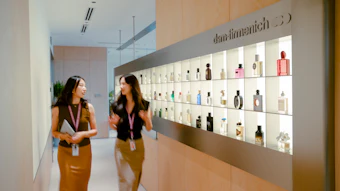
L'Oréal Luxe is extending fragrance beyond traditional product formats through a new partnership with DataLand, the AI-driven cultural institution co-founded by Refik Anadol and Efsun Erkılıç. Opening June 20 in Los Angeles, the 25,000-square-foot venue is positioning itself as the world’s first omni-sensory Museum of AI Arts, combining large-scale computational art, immersive environments and responsive sensory technologies.
As DataLand’s exclusive founding olfactory partner, L’Oréal Luxe developed 12 rainforest-inspired “olfactive imprints” for the museum’s inaugural exhibition, Machine Dreams: Rainforest. The scents were created in collaboration with Refik Anadol Studio using the studio’s proprietary Large Nature Model, an AI system trained on nature-derived datasets.
 The fragrances are not static ambient scents, but adaptive compositions designed to respond dynamically to both the artworks and visitor movement throughout the galleries.L'Oreal
The model is positioned as the world’s first open-source generative AI model dedicated entirely to nature. Unlike conventional large language models trained primarily on human-generated knowledge and text, the system is built using what the organization claims are ethically collected environmental data designed to capture what the studio describes as “nature’s inherent intelligence.” The initiative combines interdisciplinary scientific research with large-scale field data collection across 16 rainforest ecosystems, incorporating LiDAR scans, photogrammetry, ambisonic audio recordings and high-resolution imagery documenting flora, fauna and fungi. The model also draws from open-access datasets provided by research institutions, with the goal of creating not only a creative AI engine, but also a platform for environmental education, conservation advocacy and sensory storytelling that makes ecological issues more tangible and emotionally resonant for audiences.
According to the companies, the fragrances are not static ambient scents, but adaptive compositions designed to respond dynamically to both the artworks and visitor movement throughout the galleries.
The project marks a notable expansion of fragrance’s role within experiential luxury and cultural programming. Rather than centering scent around a consumer product launch or branded activation, L’Oréal Luxe is embedding fragrance into a permanent institutional art setting, positioning olfaction as an equal sensory layer alongside sound, light and digital imagery. The installation also underscores growing industry interest in computational creativity, responsive environments and multisensory storytelling as luxury fragrance houses increasingly explore AI-assisted development tools and immersive retail-adjacent experiences.
 Delivery is handled through smart diffuser technology integrated into the exhibition environment.L'Oreal
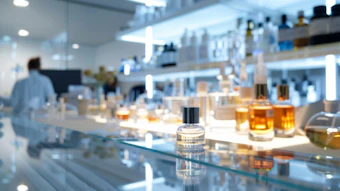
The scents themselves were developed through L’Oréal’s Fragrance Métier division, which paired AI-informed conceptual inputs with traditional perfumery construction techniques. Among the compositions is “Scent of Data,” a fragrance built around aldehydes and clean musks intended to evoke the “algorithmic pulsation” of machine intelligence. Another, “Scent of Rain,” interprets rainforest humidity through petrichor accords, earthy patchouli notes and headspace-captured atmospheric elements designed to recreate the smell of damp earth after rainfall.
Delivery is handled through smart diffuser technology integrated into the exhibition environment. According to the partners, the system adjusts scent diffusion in real time based on the artworks being displayed and visitor presence within the space, creating what the companies describe as “living scents.” The approach reflects broader experimentation across the fragrance sector around programmable scent systems, environmental diffusion and adaptive sensory interfaces that move beyond conventional personal fragrance applications.
For L’Oréal Luxe, the collaboration also serves as a high-profile demonstration of its “Culture de l’Écart” innovation framework, which emphasizes cross-disciplinary partnerships and unconventional creative formats. Cyril Chapuy, president of L’Oréal Luxe, described the partnership as an opportunity to place olfaction “at the very center of the museum,” while Karine Lebret, fragrance métier international director at L'Oréal Groupe, characterized the installation as a way to showcase immersive scent creation through “unfiltered sensory truths.”
For Anadol and Erkılıç, the partnership continues the studio’s longstanding focus on collaborative, data-driven art practices that merge machine intelligence with human perception. By incorporating responsive fragrance into the exhibition architecture, DataLand expands the conversation around AI-generated art beyond visual output, exploring how scent can function as an emotional and memory-triggering interface within computational environments.